Buy maschinen.eu ?
We are moving the project
maschinen.eu .
Are you interested in purchasing the domain
maschinen.eu ?
domain@kv-gmbh.de · 0541-91531010
Buy maschinen.eu ?
How can one learn to become an electronics technician for industrial engineering or automation technology?
To become an electronics technician for industrial engineering or automation technology, one can start by pursuing a relevant educational program, such as an associate degree in electronics engineering technology or industrial automation. These programs typically cover topics such as electrical circuits, industrial control systems, and automation technologies. Additionally, gaining hands-on experience through internships or apprenticeships with companies in the industrial engineering or automation field can provide valuable practical skills. Seeking professional certifications, such as those offered by organizations like the International Society of Automation (ISA) or the Electronics Technicians Association (ETA), can also demonstrate expertise and knowledge in the field. Finally, staying updated with the latest advancements in industrial engineering and automation technology through continuous learning and professional development is essential for a successful career in this field. **
How does one switch from an electronics technician for industrial engineering to an electronics technician for automation technology?
To switch from being an electronics technician for industrial engineering to automation technology, one can start by gaining knowledge and skills specific to automation technology through courses, workshops, or certifications. It is important to familiarize oneself with automation systems, PLC programming, robotics, and other relevant technologies. Networking with professionals in the automation industry and seeking opportunities for hands-on experience in automation projects can also be beneficial. Updating one's resume and highlighting any relevant experience or skills related to automation technology will help in transitioning to a new role as an electronics technician for automation technology. **

Similar search terms for 2020
Top-Angebote
Products related to 2020:
-
'Garnellen' Tropfltalhof 2020Tröpfltalhof's White "Garnellen" comes from the skilled hands of Andres Dichristin, a wine artisan who works 3 hectares of his land entirely planted with vines near Lake Kaltern, a place with a vocation for producing wine with authentic and traditional flavours. Andreas can be considered a vanguardist since he was among the first brave ones to adopt some 20 years ago the principles of biodynamic agriculture when it was still unknown. His work revolves entirely around respect for nature: only by observing the natural phases of plant growth and development can we understand the ideal harmonious balance for wines of sublime quality. Furthermore, his activity can be defined as closed-cycle since it also includes raising and grazing animals and cultivating spelt and corn. The grapes of Tröpfltalhof's White "Garnellen" grow on vines of different ages, ranging from 18 to 32 years. The vineyard is located at about 500 meters above sea level, and the soil is mainly composed of skeleton mixed with volcanic porphyry and limestone for a final product with a structured character; the surrounding ecosystem is also particular, thriving and dense thanks to the biodynamic work carried out, a condition that benefits the clusters, giving aromatic intensity. The grapes are harvested manually in late autumn when the berries have reached a golden yellow colour and full flavour; in the cellar, the must ferments spontaneously in terracotta amphorae. The skins and wine are separated in the spring following the harvest; the latter returns to the amphora on the noble lees for several months. To the eye, Tröpfltalhof's "Garnellen" appears deep golden yellow. The bouquet of aromas is broad and reminiscent of passion fruit, citrus and ripe yellow-fleshed fruit with important spicy notes of ginger, white pepper, citrus (grapefruit above all) and herbs. On the palate, it is full-bodied, enveloping and juicy with long final persistence that draws the drinker in, thanks in part to the final freshness and savoriness that give balance to the overall structure. It is recommended to pair it with rich fish soups, stewed white meats and cured meats; also interesting with seasonal vegetable dishes and spicy foods. A product to share with lifelong friends, enjoying in the glass a wine that is the result of careful work that respects nature and the gifts it offers every day.67,00 £*Shipping: 48,00 £Secure redirect to the provider
-
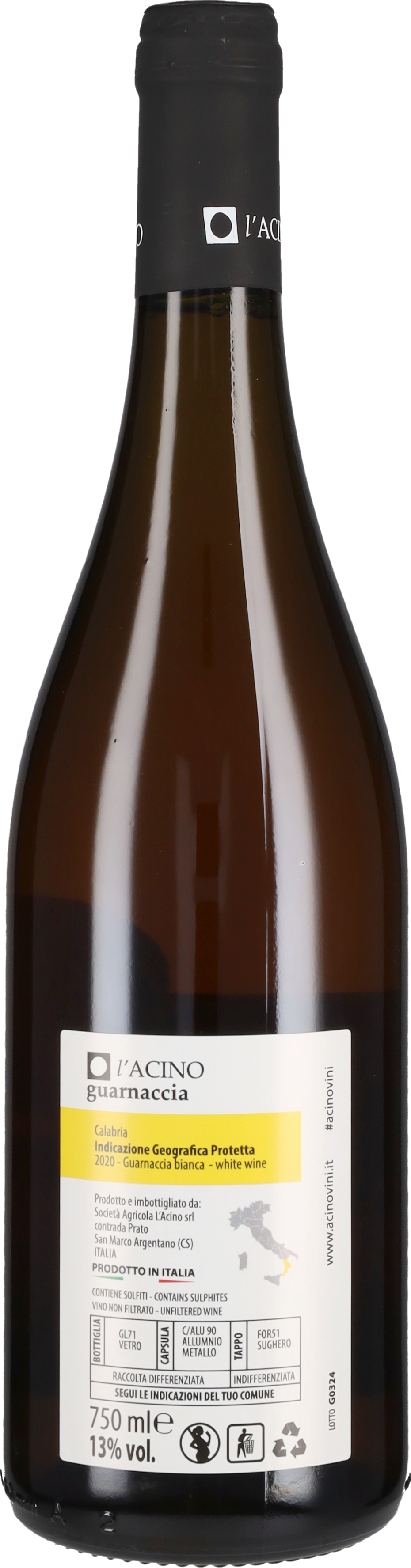
G' L'Acino 2020The “G” is a Calabrian white with a rural and direct profile. It is born from the rediscovery of a lesser-known variety, Guarnaccia Bianca - cultivated only in the province of Cosenza - which expresses itself at the final sip with a Mediterranean and briny soul, offering aromas of aromatic herbs and a savory taste. A label that tells the love of three friends, Antonello, Emilio, and Dino – owners of the L’Acino winery – for the native grape varieties of the area, in a perspective of rediscovery and enhancement of the traditional ampelographic heritage of the region. This “G” is made from pure grapes of a little-known white grape variety in Calabria, rediscovered by the owners of the L’Acino winery: Guarnaccia Bianca. The vines of this variety are about 60 years old and grow near the municipality of Frascineto at 600 meters above sea level. The must obtained from pressing the grapes ferments spontaneously in steel thanks to the presence of indigenous yeasts, macerating on the skins for two days. Then we proceed with the aging, which lasts for 12 months in second passage tonneau. At the end of this period, we proceed with bottling and marketing. The white “G” made by the L’Acino winery presents itself visually with a hue reminiscent of gold, decidedly bright. The fruit, expressed in various shades, dominates the encounter on the nose, highlighting also spicier touches and nuances of Mediterranean scrub. On the palate, it is full-bodied, concentrated, with a broad and enveloping sip, from which emerges a beautiful savoriness combined with remarkable freshness. A label that arises from a relationship of complicity between the surrounding nature of the vineyards and the work of the winery, aimed since the beginning of its activity at enhancing this area of Calabria.25,00 £*Shipping: 48,00 £Secure redirect to the provider
-
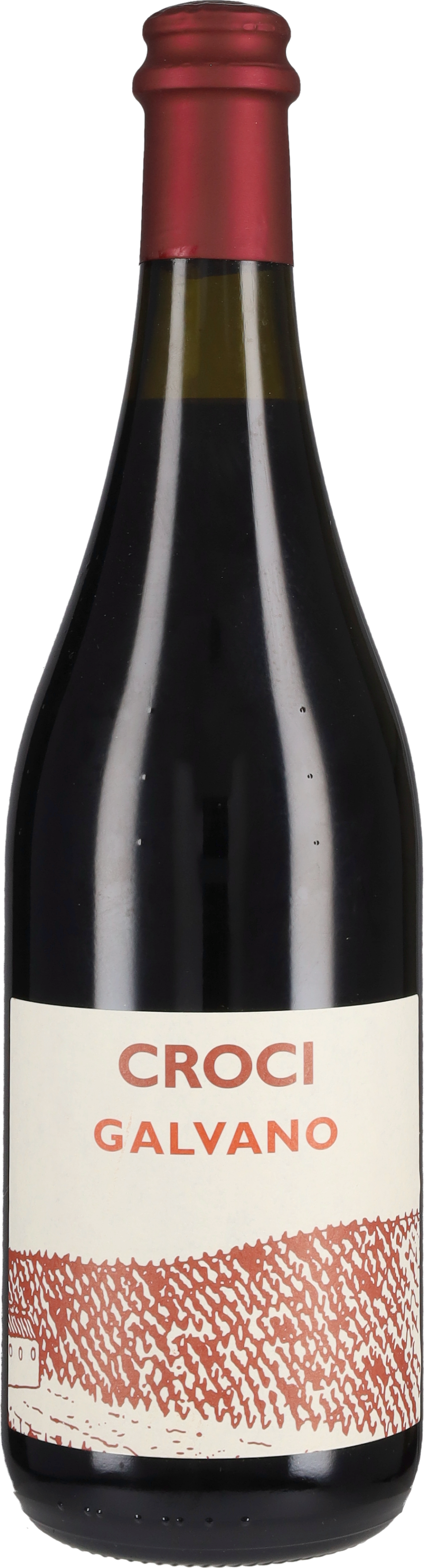
Galvano Croci 2020Galvano Croci is a delicious and satisfying wine with a distinct gastronomic vocation, a true and uncompromising liquid. Few areas like Piacentino have the power to give the wines produced here such personality that they lead back to their land of origin as soon as you put your nose in the glass by virtue of an earthy, autumnal profile of noble rusticity. Massimiliano Croci's Gutturnio Frizzante tells just that, a liquid of disarming directness capable of gratifying like few others the rich local cuisine, and representative of the philosophy of the winery founded back in 1935, then passed from father to son with the undying credo of producing wines of terroir, without any manipulation or prevarication. The vines grown are, therefore, those of tradition such as Barbera, Bonarda, Malvasia di Candia and Ortrugo, from which Massimiliano obtains different expressions, although mainly sparkling, as the local gastronomy demands. Galvano is made from a typical local blend of Barbera and Bonarda from vineyards located at 260 m. above sea level, resting on sandy-clay soils of Pliocene origin. Totally respectful farming, in which nothing but a little copper and sulfur is used, is matched by equally conscientious cellar work, with spontaneous fermentation, maceration for 8 days and refermentation in the bottle on its own yeasts. Galvano wine presents itself in the glass with an intense ruby robe. An emblematic nose, combining vinous and fragrant aspects with profound territoriality made up of references to the earth, underbrush and wet leaves. The sip is intense and flavorful, constantly enlivened by a beautiful tannic clutch and a barely noticeable bubble, but functional in immediately enticing one to take another sip.13,00 £*Shipping: 48,00 £Secure redirect to the provider
-
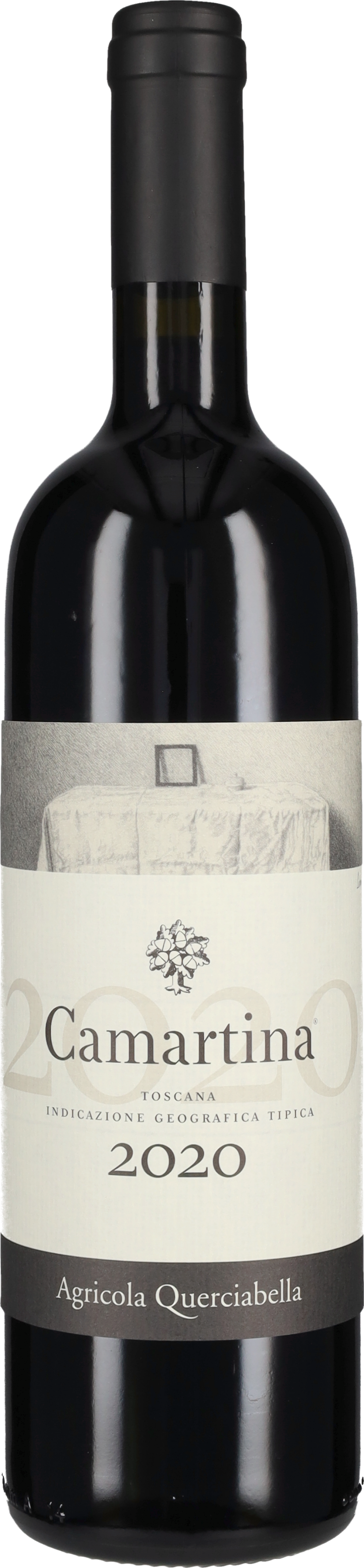
Camartina Querciabella 2020The Camartina from Querciabella is a wine of the highest quality, endowed with great personality and elegance. A red that expresses a precise character, despite its international impact. The Querciabella winery was acquired by Pepito Castiglioni in the 1970s and after the founder's passing, it is managed by Pepito's son, Sebastiano. In 1988, with great insight, the farm was converted to organic and since 2000 has introduced biodynamic practices in its vineyards, becoming a reference point in Chianti Classico for the protection of the territory and the environment. In the estate, the principles of biodynamics are applied rationally: agronomic practices are studied seriously and are the result of careful experimentation. The choice to operate biodynamically fits into a vision that is very respectful of nature on the part of Sebastiano Castiglioni. A characteristic of almost all Chianti vineyards is the rather high altitude, which gives freshness, grace, and finesse to the wines of Querciabella, particularly to this splendid Camartina. A wine that has set the winery apart in the national wine scene for its excellent production and its stylistic precision. The Camartina is a great wine, endowed with immense aging potential: an intense and elegant red, a proud product of these Chianti areas, always capable of giving us wonderful wines.78,00 £*Shipping: 48,00 £Secure redirect to the provider

-
How can one switch from an electronics technician for industrial engineering to an electronics technician for automation technology?
To switch from being an electronics technician for industrial engineering to automation technology, one can start by gaining knowledge and skills specific to automation technology through courses or training programs. It is important to familiarize oneself with automation systems, PLC programming, and control systems. Additionally, gaining hands-on experience in automation technology through internships or on-the-job training can be beneficial. Networking with professionals in the automation technology field and seeking mentorship can also help in making a successful transition. **
-
What is the difference between an electronics technician for industrial engineering and an electronics technician for automation technology?
An electronics technician for industrial engineering typically focuses on maintaining and repairing electronic systems used in various industries, such as manufacturing plants or power plants. They are responsible for ensuring that electronic equipment operates efficiently and safely within an industrial setting. On the other hand, an electronics technician for automation technology specializes in designing, installing, and maintaining automated systems that control machinery and processes. They work with programmable logic controllers (PLCs) and other advanced technologies to optimize production processes and increase efficiency in industrial automation. **
-
How do you switch from an electronics technician for industrial engineering to an electronics technician for automation technology?
To switch from being an electronics technician for industrial engineering to automation technology, you may need to acquire additional training or certifications specific to automation technology. This could involve taking courses or workshops focused on automation systems, programmable logic controllers (PLCs), robotics, and other relevant technologies. It would also be beneficial to gain practical experience in automation technology through internships or on-the-job training. Networking with professionals in the automation technology field and seeking out job opportunities that align with your new career focus can also help facilitate the transition. **
-
What is the professional title for someone who works as an electronics technician for industrial engineering or automation technology?
The professional title for someone who works as an electronics technician for industrial engineering or automation technology is typically referred to as an "Automation Technician" or "Industrial Electronics Technician." These professionals are responsible for installing, maintaining, and repairing electronic systems and equipment used in industrial settings to automate processes and improve efficiency. They play a crucial role in ensuring that machinery and systems function properly to meet production goals and quality standards. **


Which laptop is suitable for studying engineering in 2020?
For studying engineering in 2020, a suitable laptop should have a powerful processor (such as an Intel Core i5 or i7), at least 8GB of RAM, and a dedicated graphics card for running engineering software. It should also have a high-resolution display for working on detailed designs and models. Additionally, a good battery life and portability are important for working on projects and assignments on the go. Some recommended laptops for engineering students in 2020 include the Dell XPS 15, Lenovo ThinkPad P53, and the MacBook Pro. **
Are there major differences between the training for an electronics technician for industrial engineering and an electronics technician for automation technology?
Yes, there are major differences between the training for an electronics technician for industrial engineering and an electronics technician for automation technology. Electronics technicians for industrial engineering focus on the installation, maintenance, and repair of electrical systems in industrial settings, while electronics technicians for automation technology specialize in designing, programming, and maintaining automated systems and machinery. The training for automation technology may involve more advanced coursework in robotics, control systems, and programming languages compared to industrial engineering. Additionally, automation technology technicians may work more closely with engineers to develop and implement automated solutions, while industrial engineering technicians may focus more on troubleshooting and maintaining existing systems. **
Top-Angebote
Products related to 2020:
-
Inspired Deals Automatic Reset Flexible Spring Rod Limit Switch For Industrial Automation Automatic Reset Flexible Spring Rod Limit Switch For Industrial AutomationGet dependable position detection without adding complexity to your setup. The ME9101 limit switch uses a flexible wobblestick actuator that responds to machine movement or object contact and automatically returns after actuation. Designed for...39,97 $*Shipping: 0,00 $Secure redirect to the provider
-
'Garnellen' Tropfltalhof 2020Tröpfltalhof's White "Garnellen" comes from the skilled hands of Andres Dichristin, a wine artisan who works 3 hectares of his land entirely planted with vines near Lake Kaltern, a place with a vocation for producing wine with authentic and traditional flavours. Andreas can be considered a vanguardist since he was among the first brave ones to adopt some 20 years ago the principles of biodynamic agriculture when it was still unknown. His work revolves entirely around respect for nature: only by observing the natural phases of plant growth and development can we understand the ideal harmonious balance for wines of sublime quality. Furthermore, his activity can be defined as closed-cycle since it also includes raising and grazing animals and cultivating spelt and corn. The grapes of Tröpfltalhof's White "Garnellen" grow on vines of different ages, ranging from 18 to 32 years. The vineyard is located at about 500 meters above sea level, and the soil is mainly composed of skeleton mixed with volcanic porphyry and limestone for a final product with a structured character; the surrounding ecosystem is also particular, thriving and dense thanks to the biodynamic work carried out, a condition that benefits the clusters, giving aromatic intensity. The grapes are harvested manually in late autumn when the berries have reached a golden yellow colour and full flavour; in the cellar, the must ferments spontaneously in terracotta amphorae. The skins and wine are separated in the spring following the harvest; the latter returns to the amphora on the noble lees for several months. To the eye, Tröpfltalhof's "Garnellen" appears deep golden yellow. The bouquet of aromas is broad and reminiscent of passion fruit, citrus and ripe yellow-fleshed fruit with important spicy notes of ginger, white pepper, citrus (grapefruit above all) and herbs. On the palate, it is full-bodied, enveloping and juicy with long final persistence that draws the drinker in, thanks in part to the final freshness and savoriness that give balance to the overall structure. It is recommended to pair it with rich fish soups, stewed white meats and cured meats; also interesting with seasonal vegetable dishes and spicy foods. A product to share with lifelong friends, enjoying in the glass a wine that is the result of careful work that respects nature and the gifts it offers every day.67,00 £*Shipping: 48,00 £Secure redirect to the provider
-
G' L'Acino 2020The “G” is a Calabrian white with a rural and direct profile. It is born from the rediscovery of a lesser-known variety, Guarnaccia Bianca - cultivated only in the province of Cosenza - which expresses itself at the final sip with a Mediterranean and briny soul, offering aromas of aromatic herbs and a savory taste. A label that tells the love of three friends, Antonello, Emilio, and Dino – owners of the L’Acino winery – for the native grape varieties of the area, in a perspective of rediscovery and enhancement of the traditional ampelographic heritage of the region. This “G” is made from pure grapes of a little-known white grape variety in Calabria, rediscovered by the owners of the L’Acino winery: Guarnaccia Bianca. The vines of this variety are about 60 years old and grow near the municipality of Frascineto at 600 meters above sea level. The must obtained from pressing the grapes ferments spontaneously in steel thanks to the presence of indigenous yeasts, macerating on the skins for two days. Then we proceed with the aging, which lasts for 12 months in second passage tonneau. At the end of this period, we proceed with bottling and marketing. The white “G” made by the L’Acino winery presents itself visually with a hue reminiscent of gold, decidedly bright. The fruit, expressed in various shades, dominates the encounter on the nose, highlighting also spicier touches and nuances of Mediterranean scrub. On the palate, it is full-bodied, concentrated, with a broad and enveloping sip, from which emerges a beautiful savoriness combined with remarkable freshness. A label that arises from a relationship of complicity between the surrounding nature of the vineyards and the work of the winery, aimed since the beginning of its activity at enhancing this area of Calabria.25,00 £*Shipping: 48,00 £Secure redirect to the provider
-
How can one learn to become an electronics technician for industrial engineering or automation technology?
To become an electronics technician for industrial engineering or automation technology, one can start by pursuing a relevant educational program, such as an associate degree in electronics engineering technology or industrial automation. These programs typically cover topics such as electrical circuits, industrial control systems, and automation technologies. Additionally, gaining hands-on experience through internships or apprenticeships with companies in the industrial engineering or automation field can provide valuable practical skills. Seeking professional certifications, such as those offered by organizations like the International Society of Automation (ISA) or the Electronics Technicians Association (ETA), can also demonstrate expertise and knowledge in the field. Finally, staying updated with the latest advancements in industrial engineering and automation technology through continuous learning and professional development is essential for a successful career in this field. **
-
How does one switch from an electronics technician for industrial engineering to an electronics technician for automation technology?
To switch from being an electronics technician for industrial engineering to automation technology, one can start by gaining knowledge and skills specific to automation technology through courses, workshops, or certifications. It is important to familiarize oneself with automation systems, PLC programming, robotics, and other relevant technologies. Networking with professionals in the automation industry and seeking opportunities for hands-on experience in automation projects can also be beneficial. Updating one's resume and highlighting any relevant experience or skills related to automation technology will help in transitioning to a new role as an electronics technician for automation technology. **
-
How can one switch from an electronics technician for industrial engineering to an electronics technician for automation technology?
To switch from being an electronics technician for industrial engineering to automation technology, one can start by gaining knowledge and skills specific to automation technology through courses or training programs. It is important to familiarize oneself with automation systems, PLC programming, and control systems. Additionally, gaining hands-on experience in automation technology through internships or on-the-job training can be beneficial. Networking with professionals in the automation technology field and seeking mentorship can also help in making a successful transition. **
-
What is the difference between an electronics technician for industrial engineering and an electronics technician for automation technology?
An electronics technician for industrial engineering typically focuses on maintaining and repairing electronic systems used in various industries, such as manufacturing plants or power plants. They are responsible for ensuring that electronic equipment operates efficiently and safely within an industrial setting. On the other hand, an electronics technician for automation technology specializes in designing, installing, and maintaining automated systems that control machinery and processes. They work with programmable logic controllers (PLCs) and other advanced technologies to optimize production processes and increase efficiency in industrial automation. **
Similar search terms for 2020
-
Galvano Croci 2020Galvano Croci is a delicious and satisfying wine with a distinct gastronomic vocation, a true and uncompromising liquid. Few areas like Piacentino have the power to give the wines produced here such personality that they lead back to their land of origin as soon as you put your nose in the glass by virtue of an earthy, autumnal profile of noble rusticity. Massimiliano Croci's Gutturnio Frizzante tells just that, a liquid of disarming directness capable of gratifying like few others the rich local cuisine, and representative of the philosophy of the winery founded back in 1935, then passed from father to son with the undying credo of producing wines of terroir, without any manipulation or prevarication. The vines grown are, therefore, those of tradition such as Barbera, Bonarda, Malvasia di Candia and Ortrugo, from which Massimiliano obtains different expressions, although mainly sparkling, as the local gastronomy demands. Galvano is made from a typical local blend of Barbera and Bonarda from vineyards located at 260 m. above sea level, resting on sandy-clay soils of Pliocene origin. Totally respectful farming, in which nothing but a little copper and sulfur is used, is matched by equally conscientious cellar work, with spontaneous fermentation, maceration for 8 days and refermentation in the bottle on its own yeasts. Galvano wine presents itself in the glass with an intense ruby robe. An emblematic nose, combining vinous and fragrant aspects with profound territoriality made up of references to the earth, underbrush and wet leaves. The sip is intense and flavorful, constantly enlivened by a beautiful tannic clutch and a barely noticeable bubble, but functional in immediately enticing one to take another sip.13,00 £*Shipping: 48,00 £Secure redirect to the provider
-
Camartina Querciabella 2020The Camartina from Querciabella is a wine of the highest quality, endowed with great personality and elegance. A red that expresses a precise character, despite its international impact. The Querciabella winery was acquired by Pepito Castiglioni in the 1970s and after the founder's passing, it is managed by Pepito's son, Sebastiano. In 1988, with great insight, the farm was converted to organic and since 2000 has introduced biodynamic practices in its vineyards, becoming a reference point in Chianti Classico for the protection of the territory and the environment. In the estate, the principles of biodynamics are applied rationally: agronomic practices are studied seriously and are the result of careful experimentation. The choice to operate biodynamically fits into a vision that is very respectful of nature on the part of Sebastiano Castiglioni. A characteristic of almost all Chianti vineyards is the rather high altitude, which gives freshness, grace, and finesse to the wines of Querciabella, particularly to this splendid Camartina. A wine that has set the winery apart in the national wine scene for its excellent production and its stylistic precision. The Camartina is a great wine, endowed with immense aging potential: an intense and elegant red, a proud product of these Chianti areas, always capable of giving us wonderful wines.78,00 £*Shipping: 48,00 £Secure redirect to the provider
-
Maldafrica Cos 2020Cos Winery's Maldafrica was born deep in southeastern Sicily, near Vittoria. It is an atypical and distinctive Sicilian red, the result of a classic blend of Bordeaux varietals, Cabernet Sauvignon and Merlot, to which is added a small percentage of the indigenous Frappato. The territorial character and artisanal face blend with aromas reminiscent of the great models of Bordeaux reds and the profile of famous internationally inspired wines. The long ageing in wood allows a complex evolution of aromas and a perfect maturation of tannins and gives a rich and enveloping taste. Maldafrica wine was born in one of the most innovative and famous wineries in the Ragusa area, The Cos winery is located near Vittoria and has established itself with a production of artisanal-style wines endowed with a unique personality. The estate covers an area of about 30 hectares where vines live with olive, carob and almond trees within an unspoiled environmental context. The vineyards are managed under organic farming, and winemaking is conducted in the simplest way possible, often using ancient terracotta doliums. A choice aimed at minimal human intervention in order to bring to the fore and enhance the varietal aromas of the grapes and the character of the terroir. Thanks to these clear choices and perfect stylistic consistency, Cos' wines have been able to win over the palates of enthusiasts in search of authentic flavours. The Maldafrica red from the Sicilian winery Cos is a surprising wine, capable of interpreting the best-known Bordeaux varieties in a Sicilian key with the straightforward style typical of Cos wines. It is a red of great expressive power with Mediterranean hints that recall the warmth of the generous Sicilian soil. The vineyards are cultivated on red soils consisting of sands, limestone and clays and are about 250 meters above sea level. Fermentation takes place in cement or terracotta dolium tanks spontaneously and with only indigenous yeasts. The wine matures for 12 months in Slavonian oak barrels and ends the ageing period with 6 months in the bottle. In the goblet, it has a deep ruby red colour. The aromas are reminiscent of ripe cherries and small berries. The sip is deep, soft and rich, with dense, ripe tannins. A Sicilian red not very long, but certainly exciting that leaves you with nostalgia in your mouth for the sip that has just passed. The nostalgia of an imaginary trip to Africa, the nostalgia of Cos's Madafrica.23,00 £*Shipping: 48,00 £Secure redirect to the provider
-
Quartara Lunarossa 2020vintages, from 60 to 90 days: the skins of the grapes progressively release color and aromatic substances and the wine is enriched in structure also thanks to contact with the fine lees. Once this process is completed, the wine rests in oak barrels for about a year and is bottled without filtration and without clarification. The Quartara Lunarossa presents itself as an intense and complex white wine with a deep golden yellow color, slightly opaque. Its bouquet is rich and broad and recalls candied fruit, honey, ginger, spices, anise, and fennel. On the palate, it reveals a full and voluminous sip, endowed with a fresh and mineral personality, which extends towards a persistent and vanilla finish. We are talking about a wine with a good aging potential, already in great shape, but we are sure that over time it can reach peaks of great excellence. Modernity and ancient tradition pulse in unison at the heart of Quartara.vintages, from 60 to 90 days: the skins of the grapes progressively release color and aromatic substances and the wine is enriched in structure also thanks to contact with the fine lees. Once this process is completed, the wine rests in oak barrels for about a year and is bottled without filtration and without clarification. The Quartara Lunarossa presents itself as an intense and complex white wine with a deep golden yellow color, slightly opaque. Its bouquet is rich and broad and recalls candied fruit, honey, ginger, spices, anise, and fennel. On the palate, it reveals a full and voluminous sip, endowed with a fresh and mineral personality, which extends towards a persistent and vanilla finish. We are talking about a wine with a good aging potential, already in great shape, but we are sure that over time it can reach peaks of great excellence. Modernity and ancient tradition pulse in unison at the heart of Quartara.29,00 £*Shipping: 48,00 £Secure redirect to the provider
-
How do you switch from an electronics technician for industrial engineering to an electronics technician for automation technology?
To switch from being an electronics technician for industrial engineering to automation technology, you may need to acquire additional training or certifications specific to automation technology. This could involve taking courses or workshops focused on automation systems, programmable logic controllers (PLCs), robotics, and other relevant technologies. It would also be beneficial to gain practical experience in automation technology through internships or on-the-job training. Networking with professionals in the automation technology field and seeking out job opportunities that align with your new career focus can also help facilitate the transition. **
-
What is the professional title for someone who works as an electronics technician for industrial engineering or automation technology?
The professional title for someone who works as an electronics technician for industrial engineering or automation technology is typically referred to as an "Automation Technician" or "Industrial Electronics Technician." These professionals are responsible for installing, maintaining, and repairing electronic systems and equipment used in industrial settings to automate processes and improve efficiency. They play a crucial role in ensuring that machinery and systems function properly to meet production goals and quality standards. **
-
Which laptop is suitable for studying engineering in 2020?
For studying engineering in 2020, a suitable laptop should have a powerful processor (such as an Intel Core i5 or i7), at least 8GB of RAM, and a dedicated graphics card for running engineering software. It should also have a high-resolution display for working on detailed designs and models. Additionally, a good battery life and portability are important for working on projects and assignments on the go. Some recommended laptops for engineering students in 2020 include the Dell XPS 15, Lenovo ThinkPad P53, and the MacBook Pro. **
-
Are there major differences between the training for an electronics technician for industrial engineering and an electronics technician for automation technology?
Yes, there are major differences between the training for an electronics technician for industrial engineering and an electronics technician for automation technology. Electronics technicians for industrial engineering focus on the installation, maintenance, and repair of electrical systems in industrial settings, while electronics technicians for automation technology specialize in designing, programming, and maintaining automated systems and machinery. The training for automation technology may involve more advanced coursework in robotics, control systems, and programming languages compared to industrial engineering. Additionally, automation technology technicians may work more closely with engineers to develop and implement automated solutions, while industrial engineering technicians may focus more on troubleshooting and maintaining existing systems. **
* All prices are inclusive of VAT and, if applicable, plus shipping costs. The offer information is based on the details provided by the respective shop and is updated through automated processes. Real-time updates do not occur, so deviations can occur in individual cases. ** Note: Parts of this content were created by AI.